


How to hitch a caravan to a car
Hitching up a caravan is straightforward enough and comes easily with practice. Try to follow the same routine every time.
Most caravans have a hitch, crank wheel, electric hook up, latch and lock, breakaway cable and handbrake at the front. Make sure you are familiar with all of these before attempting to hitch your caravan.
Hitching up step by step
1. Engage the caravan handbrake and chock the caravan wheels (particularly, if on a slope) and raise the corner steadies.
2. Check the noseweight buy using a gauge or a set of bathroom scales.
3. Raise the hitch up above the height of the towbar with the jockey wheel and reverse the car (with assistance) up to the caravan. NB. For your safety, you are strongly advised not to stand between the car and the caravan, keep the car windows open so you can hear instructions clearly.
4. Engage the car’s handbrake fully and then release the caravan handbrake fully
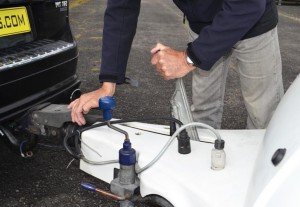
5. Move the hitch over the towball

6. Hook up the breakaway cable. This will activate the van’s handbrake if the van becomes detached from the car. It should be the first thing attached when hitching and the last thing off when unhitching. To attach, loop the breakaway cable around the towball and back on itself. Some towballs have a dedicated eye to attach cables. If so, the cable should be looped through the eye and back on itself, not clipped directly to it.
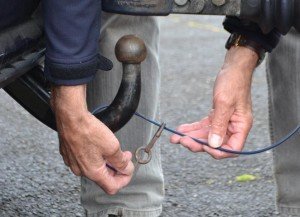
7. Lower the hitch head using the jockey wheel onto the towball until it clicks into position.

8. Engage the hitchhead stabiliser by pressing down on it, this activates the two pads on the towball and stabilises the caravan.
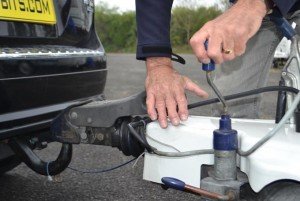
9. Check whether the towball is securely sitting in place. This step is essential, so don’t forget to do so. Double check by winding the jockey wheel back down. If the hitch has been attached correctly, the rear of the car should also rise with the van.

NB. Modern Al-Ko chassis have a button that pops out to indicate the hitch is correctly engaged. If you haven’t got a positive green button then it is not completely attached. BPW versions have a small gauge, which allows you to monitor the towball’s progress as it slides into place.
10. Wind up the jockey wheel until it’s in it’s travelling position and clamp with the locking lever.
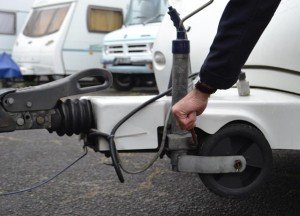
11. Connect the caravan electrics to the car socket.
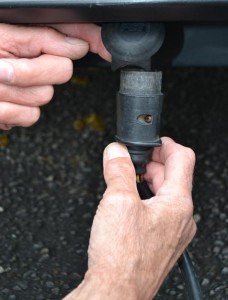
NB. Don’t let the caravan electrics cable hang down too low, make a twist above the cable to shorten it. Don’t wrap the cable around the handbrake to shorten it, as this may prevent the handbrake from working in the event of an accident. Use cable ties to secure if necessary.

12. Check all lights, indicators, reversing lights etc on the car and the caravan
13. Release the caravan hand brake

14. Re-check the coupling, breakaway cable and electrical connections and caravan brake lever.
15. Collect any chocks and corner steady pads
For more information check out our video ‘How to Hitch a Caravan to a Car” on our YouTube channel.
Unhitching
Once you have hitched up, unhitching your caravan will be easy:
1. Engage the handbreak
2. Lower the jockey wheel
3. Chock the wheels
4. Disconnect the towing electrics and ensure they are stowed safely to avoid damage
5. Release stabiliser by raising the front of the caravan on the jockey wheel and releasing the coupling clear of the hitch ball.
6. Disconnect breakaway cable and stow carefully
7. Move car away from caravan
8. Lower corner steadies and level caravan